Inauguration of the Altana at Palazzo Altemps
Roma, 00186
- Questo evento è passato.
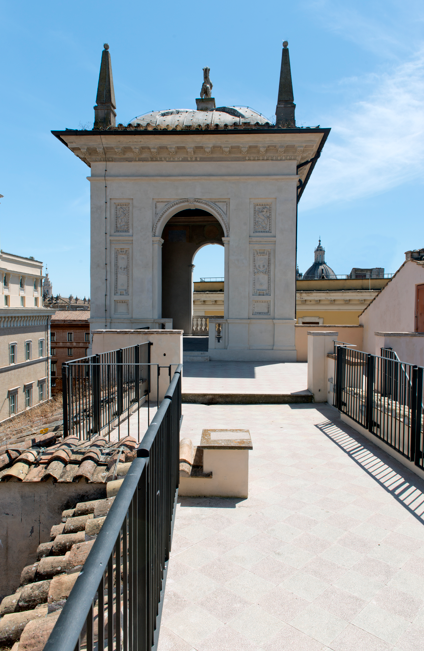
On 2 July 2025, the restoration of the roof terrace of Palazzo Altemps was inaugurated. It is one of the most fascinating examples of late Renaissance architecture in Rome, built at the end of the 16th century by Martino Longhi the Elder and completed by Onorio Longhi. Located at the south-east corner of the palace, the roof terrace stands out for its size and decorative features, which include the ibex, the heraldic symbol of the Altemps family.
The work, carried out between November 2023 and September 2024, involved both the interior and exterior of the roof terrace, restoring the legibility of the architecture and decorated surfaces: a new lighting system allows it to be viewed from below, enhancing its beauty even in the evening hours.
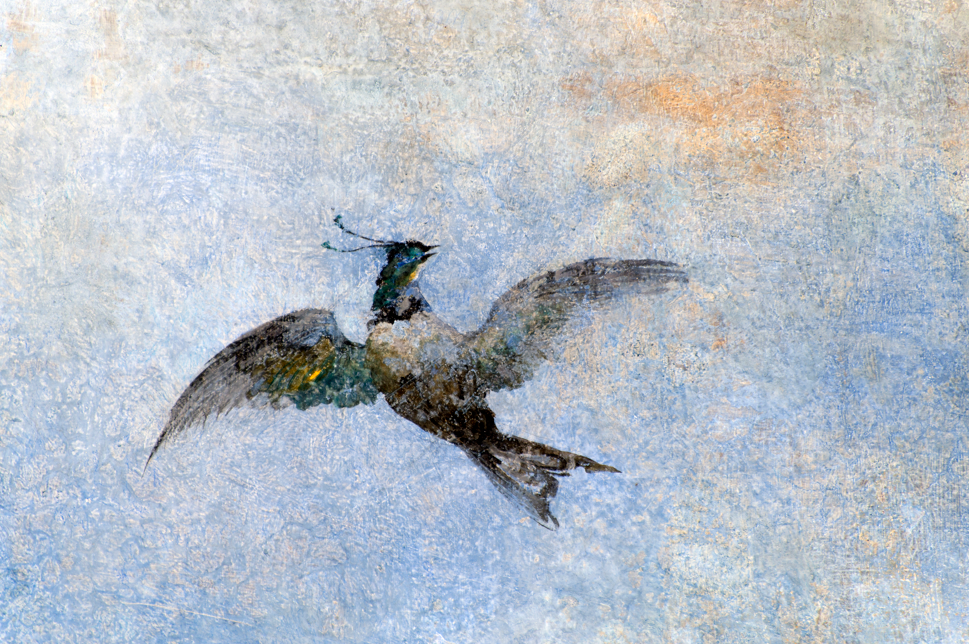
With the restoration of the interior decoration, previously hidden by heavy repainting, a clear sky of intense blue with white and ochre clouds, dotted with birds and a spectacular architectural score with openings onto a false sky on the east, south and west walls, has been brought back to light on the vault of the pavilion. The north wall, on the other hand, is completely painted blue and is bordered at the bottom by a faux marble skirting board. Unfortunately, the three east, south and west walls have lost part of their paint and supporting plaster. The intervention therefore involved the creation of new plasterwork that matches the surviving parts, with a grey shade close to the colour of the underlying roughcast, in order to enhance the reading of the context.
During the works, a targeted diagnostic investigation campaign confirmed that the recovered paintings date back to a period subsequent to the architectural construction of the roof terrace. The first layer (late 16th century) appears beneath the recovered painting and consists of a monochrome tempera with a pink/cream background and green edging. In the few preserved parts, it has been “chipped away” to allow the subsequent plaster to adhere. It was decided to leave a portion of this original layer visible in the lower section of the west wall.
The identification of the pigments used for the blue sky (artificial ultramarine blue and emerald green) and others for the birds made it possible to date the paintings to a period between 1830 and the early 20th century, most likely corresponding to the last phase of Palazzo Altemps. The restoration work has made it possible to truly understand the extensive and important 19th-century renovation to which the interior decoration of the roof terrace that we can appreciate today can be attributed.
The exterior has also been carefully restored. The plasterwork and stucco have been consolidated, the capitals have been rebuilt in continuity with those already redone in 2016, and the string course cornice is once again visible with its faux marble decorations. The travertine balustrade has been cleaned and integrated where necessary. In addition, the floor adjacent to the entrance to the roof terrace has been structurally reinforced and transformed into a panoramic terrace with a new protective railing.
The surrounding areas have been redeveloped through the revision and renovation of the plasterwork, the application of a new paint colour in harmony with the rest of the building, and the cleaning of the terrace floors.
The restoration is part of the “Urbs. From the city to the Roman countryside” project, financed with €50 million as part of the National Complementary Plan (PNC) to the PNRR. The project involved a working group within the Museum, which included restoration experts Debora Papetti and Fabiana Cozzolino, together with Laura Ruggeri, for the design and supervision of the works, archaeologist Chiara Giobbe for the promotion and enhancement of the site, and architect Saveria Petillo as technical officer and design supervisor.
The aim of the project was not only to restore the building but also to enhance the cultural and tourist value of this unique space in the heart of Rome. In particular, the aim was to highlight the roof terrace as a privileged vantage point over the roofs and domes of the city and as a new gateway to the cultural offerings of the National Roman Museum. Thanks to the evening lighting, which is also visible from Piazza Sant’Apollinare, the roof terrace has become a new urban landmark, capable of attracting citizens and visitors alike.
This intervention completes an important part of the redevelopment project launched in 1983 on the entire Palazzo Altemps complex, now one of the most prestigious locations of the National Roman Museum. The scientific direction and the work were entrusted to the Museum’s internal restorers, confirming the quality and competence that characterise the Institute’s work.
From the inauguration onwards, visitors will be able to access the roof terrace every second and third weekend of the month as part of guided tours organised by the Museum.